Trump Tells Davos “Sometimes You Need a Dictator”
© atrupar / X
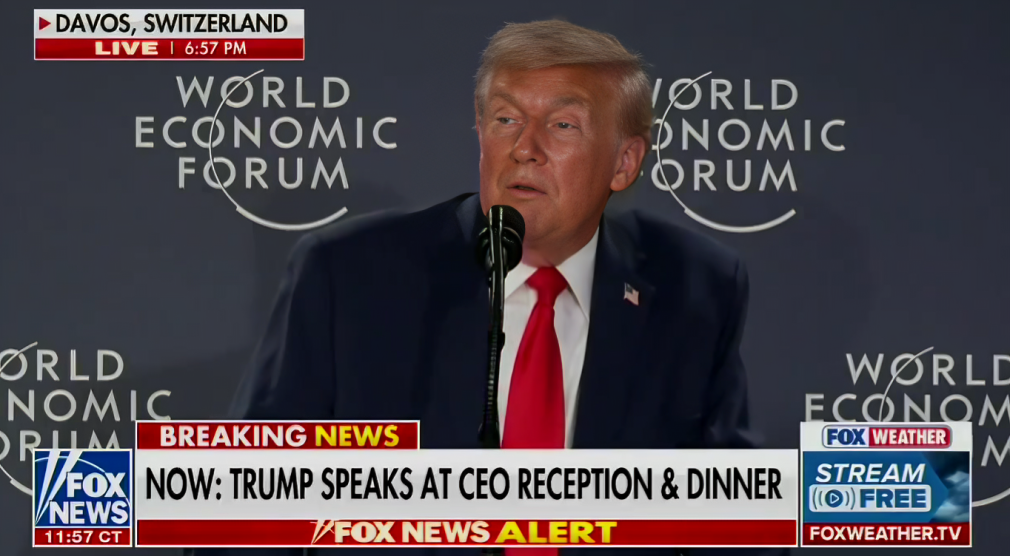
U.S. President Donald J. Trump caused a stir at the World Economic Forum (WEF) in Davos, Switzerland, on January 21, 2026, when he remarked during a reception with business leaders that “sometimes you need a dictator.” The comment followed his main address and was delivered in the context of his frustration with critics who label him as authoritarian.
Trump acknowledged that his speech earlier in the day received “great reviews,” then leaned into the controversial label: “Usually they say he’s a horrible dictator-type person. I’m a dictator. But sometimes you need a dictator.” He framed the idea as tied to common sense leadership rather than ideology, saying much of his approach isn’t strictly “conservative or liberal” but instead “95 % common sense.”
The remarks came at a reception for CEOs and global business figures after his formal Davos speech, where he touched on U.S. policy achievements, foreign policy issues such as Greenland, and broader economic themes.
Explanation and Context of Trump’s Comments
Trump’s phrasing wasn’t presented as a literal claim that the U.S. needs a dictator in a constitutional sense, and he did not outline a policy to change democratic processes. Rather, he appeared to respond to frequent accusations from critics who have used “dictator” to describe what they see as his aggressive leadership style.
Trump described his governing philosophy as practical rather than rooted in strict partisan ideology, telling his audience that he was surprised by positive reactions to his speech at Davos and stressing “common sense” as his core guiding principle.
Podium remarks and other parts of the Davos visit also addressed foreign policy concerns — particularly his administration’s ongoing push for increased U.S. influence over Greenland — and broader positions on NATO, tariffs, and economic priorities. Trump later softened earlier tough stances over Greenland by saying the U.S. would not use force and instead focus on negotiations with Denmark and its allies.
Reactions After Trump Addressed the Audience
Trump’s offhand comment quickly became a focal point after international outlets and social media highlighted the phrase. Many critics said it reinforced longstanding concerns among his opponents about authoritarian tendencies and respect for democratic norms. Left-leaning commentators and political analysts noted that linking effective governance with dictatorial power risks normalizing undemocratic language in public discourse.
Conversely, some supporters and commentators sympathetic to Trump’s approach interpreted the remark as rhetorical pushback against critics rather than a literal suggestion that dictators are preferable to democratic leaders. Discussions around the comment often centered on whether Trump was reclaiming the label to diminish criticism rather than advocating authoritarian governance.
A fact-checking outlet confirmed that Trump did make the remark in Davos — that the quoted line was accurately attributed — though analysts noted that context matters and that the remark was delivered informally rather than as a formal policy statement.
Broader Diplomatic and Political Implications
The Davos forum gathering is a high-profile moment where world leaders meet CEOs, policymakers, and global institutions to discuss economic challenges and cooperation. Trump’s remarks — especially the reference to needing a “dictator” — attracted attention not just for their tone but because they came amid other controversial parts of his speech, including his push for U.S. influence over Greenland and critiques of NATO allies.
In prior comments, Trump has occasionally joked about being a dictator — for example, saying during the 2024 campaign he’d like to be a “dictator for a day” to push certain policies — but his language at Davos was markedly more direct and unscripted than typical rally lines.
Political scientists and commentators say such remarks can reverberate beyond media soundbites by shaping how global audiences view U.S. leadership, particularly at a forum focused on cooperation, economic strategy, and collective problem-solving.
What Trump Said and What It Reflects
While Trump did not propose any changes to democratic processes, his remarks reflect broader tensions in how leaders describe strong leadership versus authoritarian rule — a subject of heated debate in domestic and international circles. Some interpret his comment as hyperbole or rhetorical defiance; others see it as a troubling flirtation with authoritarian language under the banner of decisiveness.
Observers note that public leaders often use colorful language that can be interpreted in multiple ways, but invoking a “dictator” at a global summit inevitably draws scrutiny about democratic norms and expectations of leaders in democratic nations.
You might also want to read: Donald Trump Delivers Provocative Davos 2026 Speech