Why Does Glass in Old Windows Look Wavy?

böhringer friedrich / Wikimedia Commons, CC BY-SA 2.5 (cropped)
Glass in old windows looks wavy mainly because many panes were made by hand from blown glass. The shaping process left slight curves, ripples, bubbles, and variations in thickness before the glass entered a window frame. Those irregularities distort the view through the pane and the reflections on its surface.
The familiar claim that gravity pulled the glass downward over centuries does not fit the manufacturing evidence or modern research. The waviness is better understood as a surviving record of how the pane was formed.
The Wave Was Made Into the Pane
Historic England describes traditional crown and broad glass as having subtle imperfections, including slight curves or waves that distort the view. Seen from across a room, a straight roofline may appear to bend, while reflected clouds can seem to shimmer.
These effects are not signs that the pane is moving today. They come from a surface that was never perfectly uniform. Marks such as circular patterns, elongated bubbles, or a thickened area can also offer clues about the particular method used to make it.
How Crown Glass Acquired Its Ripples
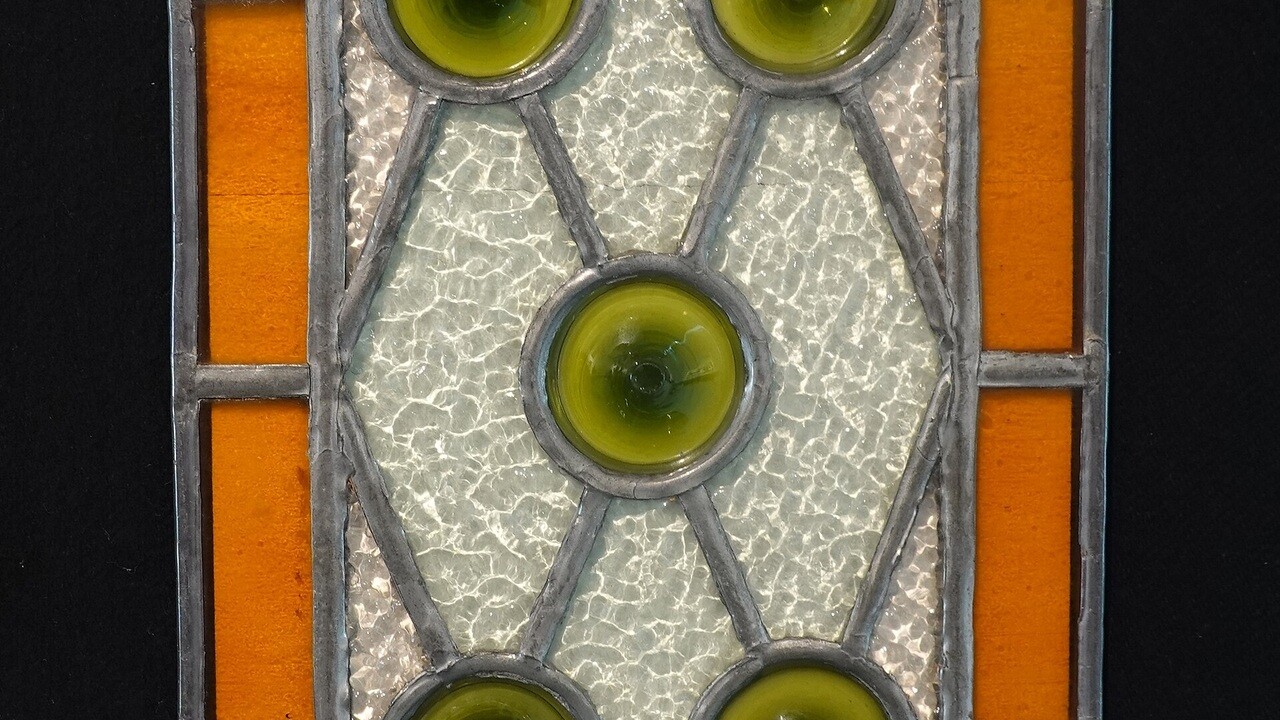
According to the Corning Museum of Glass, crown glass began as a blown form attached to a pontil rod. The glassmaker cut it open, spun it rapidly, and repeatedly reheated it until centrifugal force opened it into a disk. After cooling slowly through annealing, the disk was divided into panes.
The disk was not equally thick everywhere. Its center retained a thickened attachment point called the bull’s-eye. Crown glass can also show concentric lines caused by rotation and a slight convexity. Historic England notes that only relatively small panes could be cut from the disk’s shape.
A surviving example appears in the Science Museum Group collection: two window panes made around 1920 in the style of early crown glass and thought to be from Turkey. The museum identifies their slight convexity, concentric wavy lines, and occasional central boss as marks of the process.
Cylinder Glass Left Different Clues
Cylinder glass followed another route. Corning’s definition explains that a large gather of glass was inflated and swung into a cylinder. Its ends were removed, the tube was slit lengthwise, and the glass was reheated and flattened before it was annealed and cut into panes.
Flattening a hand-blown tube did not erase every trace of its earlier shape. Historic England says cylinder or broad glass can retain elongated bubbles and a fire-rounded edge. The surface placed against stone or metal during flattening could also remain slightly rough, helping produce the lively appearance associated with surviving handmade panes.
Why the Flowing-Glass Story Persists
The idea that old glass flowed downward sounds plausible because some panes are thicker in one area. Scientists have tested that explanation, however. A study of a representative medieval glass composition used at Westminster Abbey found that its room-temperature viscosity was far too high for measurable flow on a human timescale.
The researchers calculated a maximum movement of roughly one nanometer over one billion years. That result applies to the composition and conditions they studied, so it should not be treated as a measurement of every historic pane. Still, together with the documented manufacturing marks, it makes centuries of visible sagging an implausible explanation for ordinary waviness.
A Window Into Changing Technology
The history was not identical everywhere. In England, the earliest known crown glass dates from the 1440s, and the method remained widely used until the mid-19th century. Cylinder glass then became cheaper after glass taxation changed, according to Historic England.
Later processes pursued greater size and flatness. Drawn sheet glass appeared in the early 20th century, while float glass was invented in the late 1950s by forming glass over molten tin. Against that modern smoothness, the small variations in handmade panes are especially noticeable. They preserve the gestures and limits of an earlier craft.
The waviness is less a sign of glass changing with age than a visible fingerprint left by its maker. Have you ever noticed a familiar view bending or shimmering through an old window?
Follow The HyperHive on MSN for more stories like this.
Sources:






